
Bensalem Quality Roofing offers chimney flashing repair in Bensalem, PA, serving surrounding cities including Lower Southampton, Delran, Upper Southampton, Bristol Township and Cinnaminson. In 20+ years of tracing roof leaks, the joint between a chimney and the roof has been one of the most common sources we find, and the most common reason is flashing that was reused or sealed over with tar instead of replaced.
A chimney and a roof move independently. The roof framing expands, contracts and settles, while the masonry stays put. Flashing is what bridges that gap, and it only works when it is installed in overlapping layers that let the two move without opening a path for water.
We replace failed chimney flashing with new metal, build crickets where wide chimneys need them, and tell you plainly when the leak is coming from the masonry rather than the flashing. A straight answer saves you paying for the wrong repair.
How Chimney Flashing Works
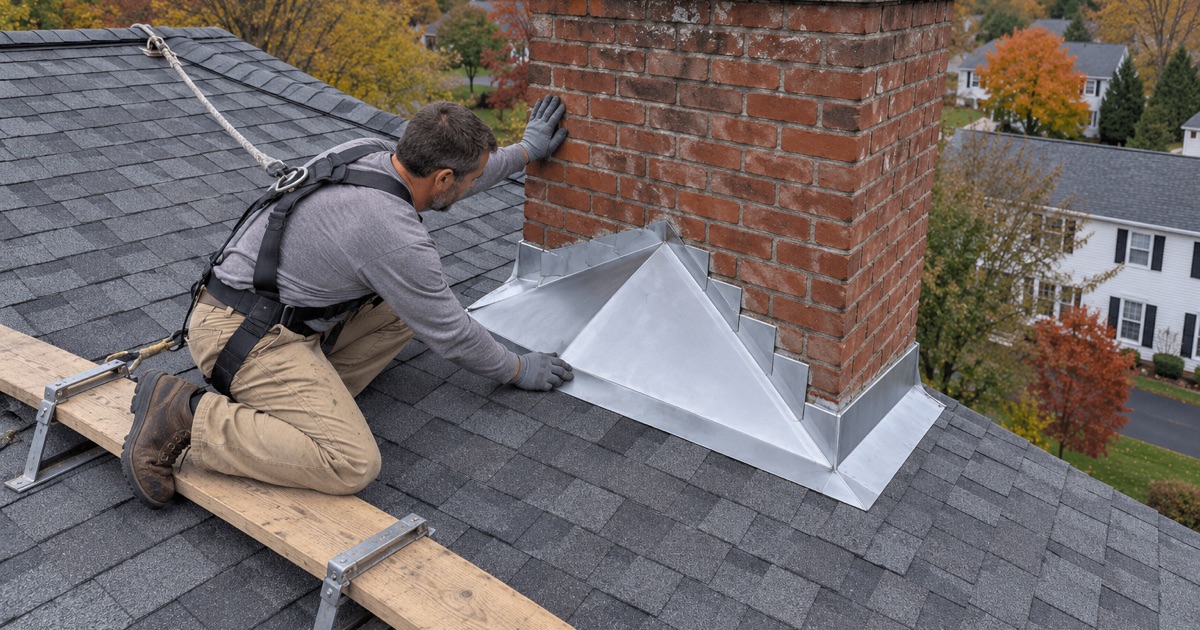
Step Flashing Along the Sides
Step flashing is a series of L-shaped metal pieces woven into each course of shingles along the sides of the chimney. Each piece overlaps the one below it, so water running down the roof is carried past the chimney and back onto the shingles. The pieces are fastened to the roof deck, not to the brick.
That separation is what lets the roof move without tearing the flashing away from the chimney. Step flashing nailed to the brick or replaced with one long bent strip will fail. We install it piece by piece with every shingle course.
Counter Flashing Cut Into the Brick
Counter flashing covers the top edge of the step flashing and is set into the masonry, usually in a groove cut into a mortar joint called a reglet. It sheds water over the step flashing below. Because it is attached to the chimney and the step flashing is attached to the roof, the two can slide past each other.
Counter flashing that is simply caulked to the face of the brick will eventually let go. We cut a proper reglet, set the counter flashing into it and seal the joint. That detail is the difference between a repair that lasts and one that needs redoing.
Apron Flashing and the Front Face
Apron flashing wraps the downhill face of the chimney and laps over the shingles below. It carries water off the front of the chimney onto the roof surface. Like the sides, it is covered by counter flashing set into the brick.
Why Chimney Flashing Fails
Flashing Reused Under a New Roof
When a roof is replaced, the old chimney flashing is sometimes bent back, left in place and covered with new shingles. Metal that has already been on a roof for many years is often corroded, bent or pulled loose. Reusing it is one of the most common causes of chimney leaks on houses with relatively new roofs.
We replace step, counter and chimney flashing with the roof rather than reusing it under new material. On a flashing-only repair, the same rule applies. New shingles around old flashing still leak.
Tar, Caulk and Roof Cement
Layers of tar or caulk around a chimney are a sign that someone has tried to stop a leak without fixing the flashing. Sealants dry and crack as the roof and chimney move, and each new layer hides the real problem a little more. They can also trap water against the brick.
We remove the old sealant, inspect what is underneath and install proper flashing. Sealant has a small role in finishing the joint, but it is never the main defense. Metal in layers does that work.
Masonry Cracks and Missing Mortar
Sometimes the flashing is fine and the water is coming through the chimney itself. A cracked crown, missing mortar joints or porous brick can let water into the chimney, where it runs down and appears in the same places a flashing leak would. We check the masonry as part of every chimney leak inspection.
When the masonry is the problem, we tell you so rather than replacing flashing that would not have stopped the leak. Some masonry repairs are best handled by a mason. We point out what we see so the right trade can fix it.
Chimney Flashing Repair and Replacement
Replacing Flashing With New Metal
A chimney flashing replacement starts by removing the shingles around the chimney and the old flashing. We then install new step flashing course by course, new apron flashing and new counter flashing set into the masonry. The area is reshingled to match.
Aluminum, Copper and Lead
Aluminum and coated steel are common choices for step flashing, while copper and lead are used for counter flashing on many chimneys because they shape well to brick and last a long time. We choose metals that work together so they do not corrode each other. You can choose copper for a visible chimney if you want it to weather to a natural patina.
Building a Chimney Cricket
A wide chimney facing up the slope acts as a dam, collecting water, leaves and in winter snow behind it. A cricket, or saddle, is a small peaked roof built behind the chimney to split the water around both sides. It is framed, sheathed, covered with ice barrier and flashed into the chimney.
Many chronic leaks from the back of a wide chimney stop once a cricket is built. We recommend one where the chimney’s width and the roof slope call for it. It is a modest addition that solves a stubborn problem.
Chimneys at Resale in Bensalem
The Chimney Certificate at Settlement
Bensalem’s residential resale use and occupancy permit requires a chimney, flue and vent certificate at NFPA 211 Level II before settlement, along with electrical and heating certificates. That inspection is done by a chimney professional and looks at the inside of the flue. If it turns up water damage, the flashing is often where the water got in, and we can repair it before settlement.
Flashing With a New Roof
If you are planning a roof replacement, chimney flashing should be replaced at the same time. The shingles are already off, so the work is simpler and the new flashing is woven into the new roof. We include it as its own line in every replacement scope.
- 20+ Years Experience
- Attic Checked on Every Leak
- Itemized Written Scopes