
Bensalem Quality Roofing does roof replacement in Bensalem, PA for homeowners and building owners, serving surrounding cities including Lower Southampton, Delran, Upper Southampton, Bristol Township and Cinnaminson. A replacement is the largest roofing decision most owners make, and after 20+ years of tear-offs we know the difference between a roof that lasts and one that leaks in year three usually comes down to flashing, ventilation and the condition of the deck.
Before we recommend replacing a roof, we make sure a repair would not do the job. When replacement is the right call, our written scope separates the tear-off, decking, underlayment, flashing, ventilation and gutters into their own lines. Two contractors’ prices can then be compared item by item instead of as two totals with nothing in common.
On a Bensalem house the permit is part of the plan from the first estimate, because the township’s fee schedule prices residential reroofing as permit work. On a house in another township or across the Delaware, we check that municipality’s rule before we write the price.
Planning a Roof Replacement in Bensalem
Bensalem’s Reroofing Permit and Fees
Under Resolution 2024-04, effective March 1, 2024, Bensalem charges $75 plus the residential permit fee for residential reroofing, along with a $15 application fee and a $4.50 UCC surcharge. Commercial, industrial and multifamily reroofing is priced at $100 for the first 3,000 square feet and $5 for each additional 1,000. The township publishes no re-roof exemption, so every Bensalem replacement we do is filed as permit work.
Permit fees are invoiced through Code Inspections, the township’s inspection agency. We file the application, schedule the job around its approval and include the fee as a line in the contract. You see exactly what the permit cost rather than finding it folded into a total.
An Itemized Written Scope
Every replacement estimate lists the tear-off and disposal, the decking allowance, the underlayment and ice barrier, the drip edge, every flashing detail, the ventilation and the gutters as separate items. If another contractor leaves one out, you can see it. Many disputes after a roof job start with a line that was never written down.
Decking is the one quantity nobody can know before the old roof comes off. Our contracts set a price per sheet, and any damaged sheet is photographed and shown to you before it is replaced. The final count matches what you saw.
Twins, Townhouses and Shared Roofs
Replacing one half of a twin or one unit of a townhouse row means tying the new roof into the neighbor’s roof and flashing the party wall so water cannot cross between them. We plan the tie-in before the job starts and talk to the neighbor when the edge of the work reaches their side. A poorly finished seam at the party wall is one of the most common leak sources on attached homes.
In a planned community or condominium, the declaration decides who is responsible for the roof. We ask for that section before scheduling, since an association that maintains roofs may need to approve or even contract the work itself.
Materials for a New Roof
Architectural Shingles and Wind Ratings
Most of our replacements use architectural, or laminated, shingles such as GAF Timberline HDZ, Owens Corning Duration or CertainTeed Landmark. They are thicker than old three-tab shingles and are tested for wind resistance under ASTM D3161 Class F or ASTM D7158 Class H. Impact-rated lines tested to UL 2218 Class 4 are available for owners who want extra hail resistance.
Color matters as much as rating, since you will see the roof every day. We bring full-size samples so you can compare them against your brick or siding outdoors. A shingle that looks gray in a brochure can read brown in afternoon light.
Underlayment and Ice Barrier
Under the shingles we install ASTM D8257 synthetic underlayment across the deck and a self-adhering ice and water barrier meeting ASTM D1970 at the eaves, in the valleys and around penetrations. The 2021 International Residential Code as adopted in Pennsylvania calls for an ice barrier at the eaves in section R905.1.2. That membrane is what stops an ice dam from pushing water into the house.
Synthetic underlayment also gives the crew safer footing and stays intact if rain interrupts the work. Felt paper tears and wrinkles easily by comparison. The extra cost is small next to the protection it adds.
Ventilation, Drip Edge and Flashing
A new roof gets drip edge at the eaves and rakes, balanced ventilation with soffit intake and a ridge vent sized by net free area, and new step, counter, apron and chimney flashing. We never reuse old flashing under new shingles, because metal that has already moved for twenty years will not seal against new material. Pipe boots are replaced as a matter of course.
Residential and Commercial Roof Replacement
1970s Houses and the Two-Layer Limit
More Bensalem homes were built in the 1970s than in any other decade, and many of those houses are now due for their second or third roof. Section R908 of the residential code does not allow a new layer over a roof that already has two, so those houses need a full tear-off. We prefer a tear-off even where one overlay is allowed, because it is the only way to see the deck.
Older houses can also have painted trim and fascia from before 1978. Where our work disturbs that paint, the EPA’s RRP lead-safe rule governs how it is handled. We plan for it in the scope rather than discovering it on the day.
Manufactured Home Roof-Overs
A manufactured home built to the HUD code under 24 CFR 3280 has a light, low-slope roof that should not be treated like a shingle roof on a stick-built house. Replacing it usually means a roof-over with its own framing or membrane system, fastened and sealed for that structure. We quote these as a separate kind of job with seams and fasteners planned for the home underneath.
Commercial Low-Slope Roof Replacement
On commercial and multifamily buildings, replacement usually means a new single-ply TPO or EPDM membrane or a torch-down modified bitumen system over new insulation. We check the deck, the drains and the rooftop units before choosing the system, and we coordinate the work around tenants and business hours. Commercial reroofing in Bensalem is priced by area on the township’s fee schedule, and we include that in the bid.
Our Step-by-Step Roof Replacement Process
Step 1: Inspection and Written Scope
We inspect the roof and attic, confirm that replacement is the honest answer, and write an itemized scope. The scope names the materials, the permit and the per-sheet decking price. You have the three-business-day cancellation window after signing a Pennsylvania contract.
Step 2: Permit and Scheduling
We file the permit for the house’s own municipality and set the start date once it is approved and the materials are on order. If solar panels have to come off, the solar contractor is booked first. You know the schedule before the dumpster arrives.
Step 3: Tear-Off and Decking
The crew protects the landscaping, strips the old roof to the deck one section at a time and inspects every sheet. Damaged decking is photographed and shown to you before it is replaced. No section is left open overnight.
Step 4: New Roof System
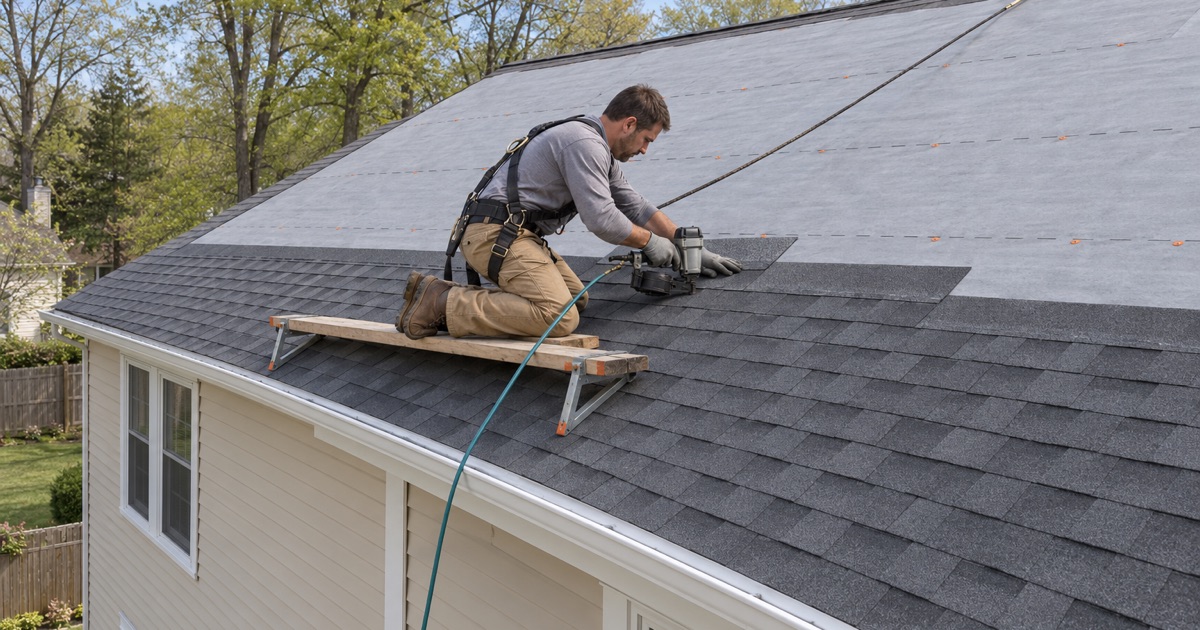
Drip edge, ice barrier, underlayment, flashing, shingles and ridge vent go on in that order, with gutters reset or replaced at the end. Each work day finishes with the gutters, driveway and yard cleaned. A magnet sweep picks up stray nails.
Step 5: Final Walk-Through
When the roof is finished we walk the property with you, review the photos and close the permit with the township’s inspection. You receive the warranty paperwork and a record of what was installed. Any question that comes up later can be answered from that record.
- 20+ Years Experience
- Attic Checked on Every Leak
- Itemized Written Scopes